Engrasi
Ofrenda a la tormentaEngrasi, Amaia Salazar’s aunt, is both a member of the family and the person who makes her home feel like a refuge. She offers Amaia physical shelter and emotional steadiness, but her care is not passive: she challenges her niece, reads tensions that others miss, and brings her own spiritual understanding to events that resist easy explanation. Across the story, the house, a tarot deck, and the river become settings and objects through which Engrasi’s particular mixture of tenderness, judgment, and belief takes shape.
The House as Refuge
For Amaia, Engrasi’s house is bound to a childhood ritual of leaving and returning. When Amaia was small, her aunt would send her out to take the rubbish away, and she would linger on the low wall by the river, looking at the warmly lit facade. The cold made the eventual return feel especially welcome. As an adult, Amaia remembers that habit while sitting outside the house at dusk, seeing its golden windows as if a small sun were burning within. She has lately been rushing inside to see Ibai, but the older ritual remains part of how she learned to recognize safety.
Engrasi’s welcome is also expressed through the ordinary life of the household. When Amaia arrives, James is in the sitting room with a book he is not reading, keeping watch over Ibai in a baby hammock on the sofa, while Engrasi gathers up the cards and counters from her regular game with friends. The scene places family care amid routine rather than ceremony: the baby is watched, the game is put away, and the household makes room for Amaia.
The house continues to receive Amaia in moments of physical exhaustion. After returning in rain and mud, with her strength nearly gone, she enters wearing wet, dirty clothes and is immediately surrounded by what she experiences as the house’s beneficial influence. Engrasi is with the family as they prepare to eat. Amaia cuts off her aunt’s likely protest, saying she is merely tired and wet, and promises to shower and sleep. The gesture reveals the familiar intimacy between them: Amaia knows Engrasi will worry, and answers that concern before it can become an argument.
Care, Family, and Independence
Engrasi’s concern reaches beyond Amaia. She notices the difficulties between Amaia and James, between Amaia and Flora, and between Flora and Ros, telling Amaia that all three problems touch her life. Her reading is striking not because she claims detachment, but because she admits the opposite: her personal involvement makes it harder to see what she does not want to see. The seriousness with which she handles the tarot cards is balanced by this frank recognition of her own limitations.
She also interprets Flora’s growing attachment to Ibai differently from Amaia. Amaia suspects that Flora’s kindness may be calculated, but Engrasi argues that Flora genuinely loves the child. She points to the months of calls in which Flora has asked after him, explaining that the interest began before Amaia noticed it. Flora had wanted children and suffered when she could not have them; in Engrasi’s view, her initial lack of interest does not cancel what changed when she met Ibai. Engrasi’s defense of Flora does not erase the sisters’ difficult relations. Rather, it shows her resisting Amaia’s suspicion with details drawn from the family’s longer history.
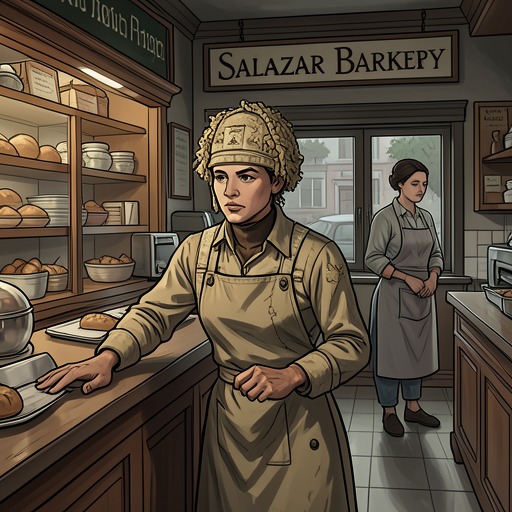
Engrasi also understands how independence can isolate the people she wants to help. As Flora and Ros struggle over the bakery, she tells Amaia that she has offered Ros assistance, although she knows the sisters’ dispute makes such help unequal. The bakery means more to Ros than it does to Flora: Ros has built her hopes around it and sees it as a major achievement. Yet Ros has refused help from both Engrasi and James, insisting that she must manage alone. Engrasi is saddened by that refusal and questions the assumption that her nieces should have to do everything by themselves.
Counsel, Tarot, and Warning
Engrasi’s relationship with Amaia allows for disagreement without secrecy. When Amaia admits that she is still in contact with Dupree, she explains that his advice helps her investigation and that he is her friend. She tells Engrasi that she needs both of them and does not want to keep hiding the calls. Engrasi responds not by accepting Amaia’s distinction between friendship and concern, but by bringing out her tarot deck, wrapped in black silk. Amaia protests; Engrasi answers that if Amaia accepts Dupree’s methods, she must accept hers as well. The exchange makes the deck more than a prop for fortune-telling: it becomes Engrasi’s claim to a place in Amaia’s efforts to understand what is happening.
Her reading names several pressures at once: serious trouble between Amaia and James, trouble between Amaia and Flora, conflict between Flora and Ros that also affects Amaia, and a dark threat still hanging over Amaia. Engrasi then warns her to be careful of Dupree, though the warning itself does not establish its grounds. Her counsel is therefore both intimate and incomplete: she speaks with confidence about the dangers she perceives, while the story leaves the basis of that particular caution unstated.
Engrasi’s interpretation of the Basajaun similarly joins careful reading with belief. She has studied the myth and its legends, and describes the figure as a guardian of balance, a lord of the forest who preserves proportion between life and death. She thinks that a grave offense has disturbed an important equilibrium and forced the figure to appear. In considering what might have caused such a rupture, she refers to the unnatural deaths of the young women killed the previous year, the monster who drove people to murder and leave victims’ remains in the valley, and the danger that came close to Ibai. She connects these crimes to the river and the forest as domains of powerful forces, while acknowledging that the reason for the imbalance remains unknown.
Doubt, Loyalty, and the Family’s Strain
Engrasi’s loyalty does not mean that she accepts every conclusion Amaia reaches. When she dresses for a funeral in a gray dress she usually reserves for such occasions and a string of pearls, she initially believes she should go. As the time approaches, however, her conviction weakens. She decides that she cannot attend the funeral of someone she does not believe is dead. Amaia receives the decision with relief and embraces her. Engrasi’s refusal is not presented as proof of what happened; it is a personal judgment that exposes the uncertainty the family has been living with.
That uncertainty has consequences for Amaia’s marriage. After Amaia leaves the room, James asks Engrasi not to encourage her fears or sustain her doubts. He says that if anyone can help her move on, it is Engrasi, and admits that he feels he is losing his wife. Engrasi is thus placed between a husband who wants the past closed and a niece whose fear has not yielded to reassurance. The scene does not say that Engrasi accepts James’s request. It makes clear, instead, that her influence is sought because Amaia trusts her—and that this trust carries a responsibility others cannot easily assume.
Grief and Narrative Role
At the end of the events represented here, Engrasi’s care becomes physical again. Amaia returns from the bridge and breaks down in her aunt’s arms, crying for fear, anger, bitterness, regret, loss, desecration, death, bones, and blood. Engrasi holds her through the long outpouring, as she had held her when she was a child. Amaia falls asleep exhausted and wakes to cry again. Engrasi laments that the doors cannot remain shut forever while her girl grieves the world’s evils. Her wish for a protected interior cannot stop what has happened, but the embrace gives Amaia the space to grieve until she is ready to act.
Engrasi’s narrative role rests on this double function: she protects a domestic refuge while refusing to pretend that the refuge can seal out the world. The old return-home ritual, her attention to family tensions, the tarot reading, and her account of a broken balance all make her a witness to different kinds of knowledge—emotional, familial, and mythic. None gives her complete control over events. What she can offer is steadiness: a home Amaia can return to, counsel that may complicate as well as comfort, and an embrace that lasts until grief has run its course.